UNDERSTANDING ESD PROTECTION
#3 How to Choose the Right ESD-Protected Packaging Material and Packaging System
Enter your email address and we will contact you:
When working with or transporting electronic components that are sensitive to electrostatic discharge (ESDS), it is very important to protect them from ESD (electrostatic discharge). A discharge — like a tiny “lightning strike” — can damage or destroy the product. Using appropriate ESD-protected packaging materials and packaging systems is an important part of this protection.
What should you consider?
ESD-protected packaging must meet customer requirements, purchasing specifications, technical drawings, or any expectations described in other documentation. The basic requirements for ESD protective packaging are defined in paragraph 5.3.5 of the IEC 61340-5-1:2024 standard.
It is also important to consider where the product will be handled or stored:
- Inside the EPA (Electrostatic Discharge Protected Area)
- Outside the EPA
- Between EPAs
- To external service providers, to the customer, or to the end user1
Types of ESD-Protected Packaging Materials and Their Applications
To select the right packaging material, clarify the following:
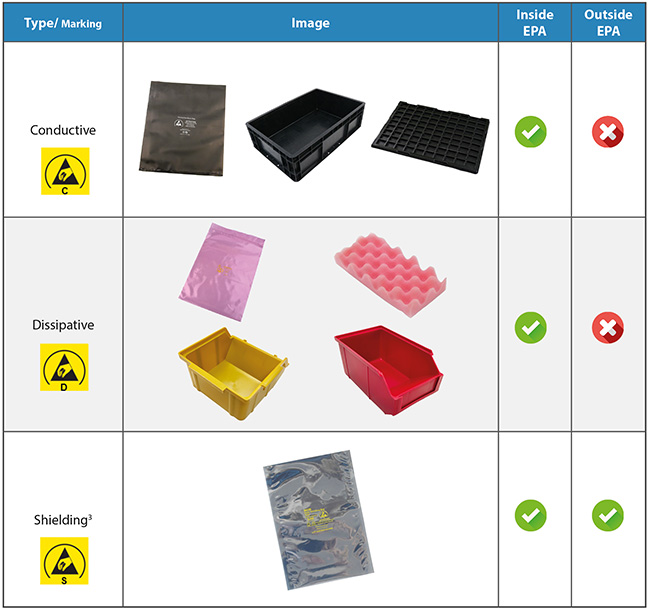
- Will the product be stored inside or outside an EPA?
- Inside an EPA, conductive or dissipative packaging is sufficient.
- Outside an EPA, shielding packaging is required to protect against discharge.
- What type of packaging is needed?
- For example: bag, foam, tray, box, or other
- Should the packaging be reusable or disposable?2
Table 1 – Where can the packaging material be used as the sole packaging?
ESD-Protected Packaging Systems
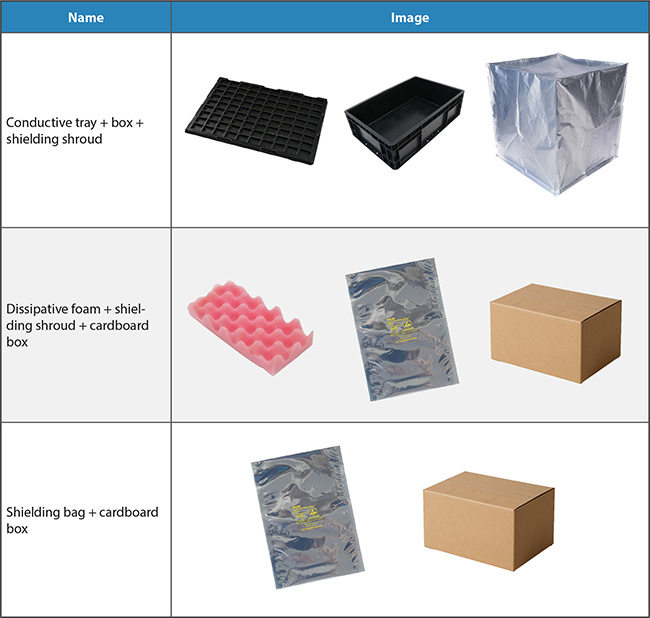
Outside an EPA, different packaging systems can be used to protect ESDS devices. Some examples:
Table 2 – Packaging Systems
Summary
Inside the EPA:
Conductive and dissipative packaging materials can be used. These do not protect the product from direct discharge, but since their material does not become electrostatically charged, they pose no risk to the product and protect it from dust and damage.
Outside the EPA:
Shielding packaging or packaging system must be used. Deviations are only acceptable when the ESD risks during transport are well understood. Shielding packaging provides reliable protection against direct discharge — from the manufacturer to the customer or end user.
Gábor Lovász, Ph.D.
|
Technical information |
Reference
1 IEC 61340-5-1:2024 Electrostatics – Part 5-1: Protection of electronic devices from electrostatic phenomena – General requirements, 2024, page 18. (paragraph 5.3.5)
2 IEC TR 61340-5-2:2018 Electrostatics – Part 5-2: Protection of electronic devices from electrostatic phenomena – User guide, 2018, pages 62., 64., (paragraphs 5.3.4.3 and 5.3.4.8)
Note
3 On this page, any reference to shielding packaging material refers in all cases to a material with a dissipative inner layer.